Not technically x5 related, beyond the fact that the motor below started life in my 4.4, maybe useful for someone doing a rebuild someday.
I finally have my block and crank back (block cleaned and crank polished) so I can get to work on the bottom end. I don't have my pistons back yet, but I can at least get the crank in with new bearing shells. First though, I decided that since this was a project, I might as well put a lap on the cylinders to help the new rings seat. I've read everything I can find on this process, and got some good advice from Peter Partee at Partee racing. Key to the process is having a profilometer on hand to see where the cylinder wall are before lapping, and then again after lapping to make sure you get them into spec. I ended up renting a profilometer for the job because, again, its a project so why not. As it turns out nothing is an exact science, even with an instrument that measures in microns.
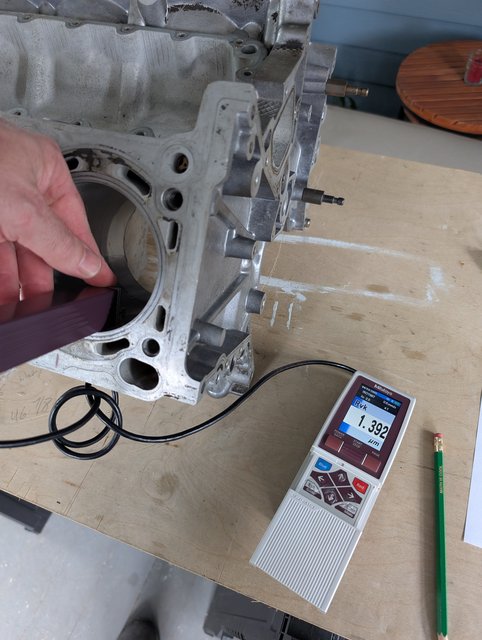
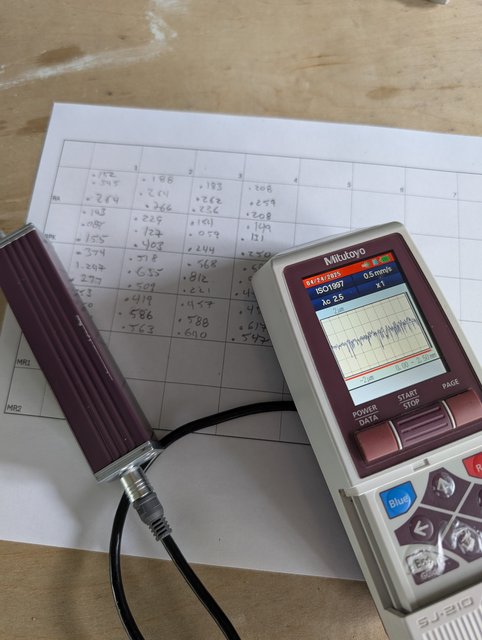
My pre-measurements generally put the cylinder walls in the .2 micron range for average height (Ra) and (mostly) in the 2 micron or below range for mean height (Rpk). There are several other measurements that I took with the profilometer, including valley depth numbers, but Rpk in particular seems to to be the most telling. Valley depth was interesting and difficult to obtain reliably because in addition to 20 years of crap in the valleys of the cylinder walls, between the silicon crystals, the lapping paste builds up in there too I think, despite vigorous cleaning with brake cleaner. I took measurements at three places on the walls, and often had to repeat the measurements several times to get numbers that made sense. Bottom line though is that all the cylinders save for a few showed wear below what my reading indicates is a minimum Rpk of 3, and a desired of .4 - .7ish.
On to lapping then. The kit I bought from AM Tuned had the felt lapping tool, a tin of the lapping compound and some directions. Basically you slather it on the walls (there is just enough for 8, plus 2 re-do cylinders), put some on your felts, and lubricate the whole mess with wd-40. Then you set your watch and start honining with a drill on low RPM (600 or below). I started at 60 seconds on cylinder one and then did about 80 seconds on number 2. After measuring 2 was showing Rpk and RA numbers of .422 and .406 while number 1 was barely at .3 microns. This lead me to lap every cylinder for about 70 to 80 seconds which produced in spec Rpk and RA numbers on all but two. I used the remaining paste to redo these two cylinders, along with number 1 and got all of the cylinders up to at least .3+ and often .4 or .5ish.
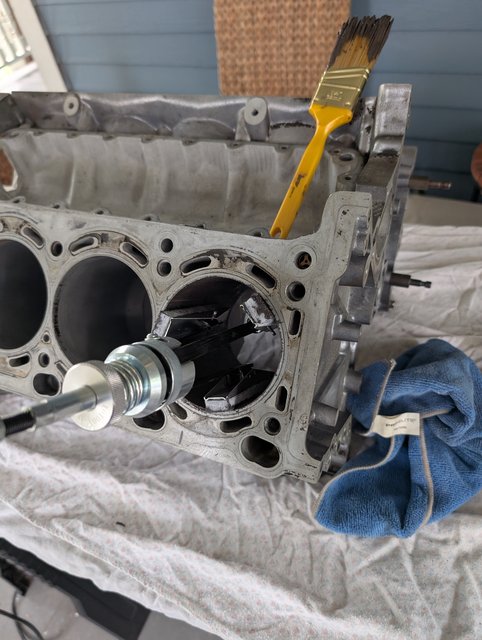
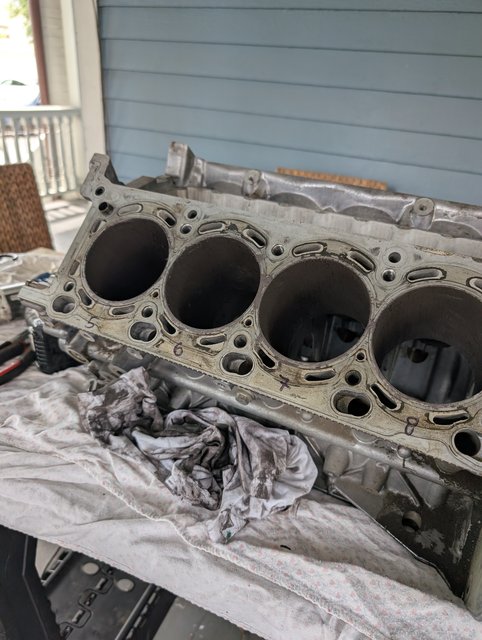
All 4 bores on one side ready for lapping in the pic above.
After lapping the bores look 80% better. Some of the wear marks are still there, but there is a much more uniform gray to them, which I read is good.
Bore 1 below has been lapped while bore 2 has not:

A messy job, but hopefully one which will pay off with the ring change.