Home Forums Articles How To's FAQ Register
Go Back   Xoutpost.com > BMW SAV Forums > X5 (E53) Forum
Fluid Motor Union
User Name
Password
Member List Premier Membership Search Today's Posts Mark Forums Read

Xoutpost server transfer and maintenance is occurring....
Xoutpost is currently undergoing a planned server migration.... stay tuned for new developments.... sincerely, the management


Reply
 
LinkBack Thread Tools Display Modes
  #1  
Old 04-19-2011, 05:40 AM
Member
 
Join Date: Jan 2011
Location: Blackburn UK
Posts: 431
RRPhil is on a distinguished road
Congratulations on your excellent write-up civdiv99.

I’ve rebuilt around a dozen Range Rover 5HP24s in the past few months which had exactly this same “bearing then O-ring” failure http://forum.landrovernet.com/showthread.php/189983-ZF-5HP24-teardown and it looks as though it will become a common problem on the 4.4i & 4.6is E53 too as their mileages rack up.

The axial needle roller bearing which wears & fails only sees a combination of load and relative speed in gears 1, 2 & 3 so I suspect it will be vehicles that have worked hard in these gears throughout the vehicle’s lifetime which will suffer this particular failure (towing, ‘sporty’ driving, hilly terrain, etc.). Vehicles that spend their lives predominantly cruising up and down the motorway are likely to be safe from this particular failure.

Please forgive me if I missed it, but reading through your excellent posts I notice that you didn’t make specific reference to the condition of the O-ring which seals the input shaft to the B-clutch drum so I think it’s worth pointing out that it’s the failure of this O-ring which allows the A-clutch pressure to bleed to tank (& therefore drive is lost in gears 1 to 4) and that the O-ring fails because the axial bearing wear allows the input shaft and B-clutch drum to separate under load (as you stated). Perhaps you could confirm that this O-ring had failed in your case?
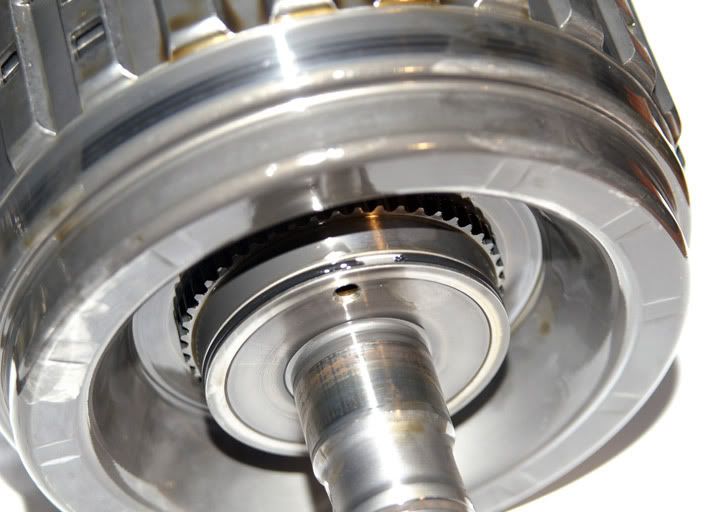
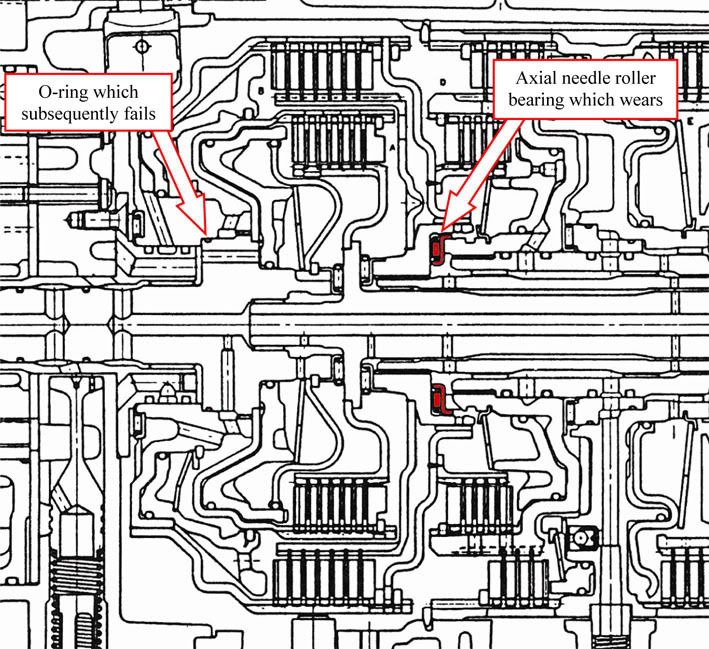


It’s easy to identify if a 5HP24 has this specific problem when it’s sat on a bench, even before stripping it, by grabbing the input shaft and trying to move it axially. The correct endfloat is 0.2 to 0.4mm. If the axial bearing has worn/failed you will be able to move the shaft by 1-2 mm.

Phil

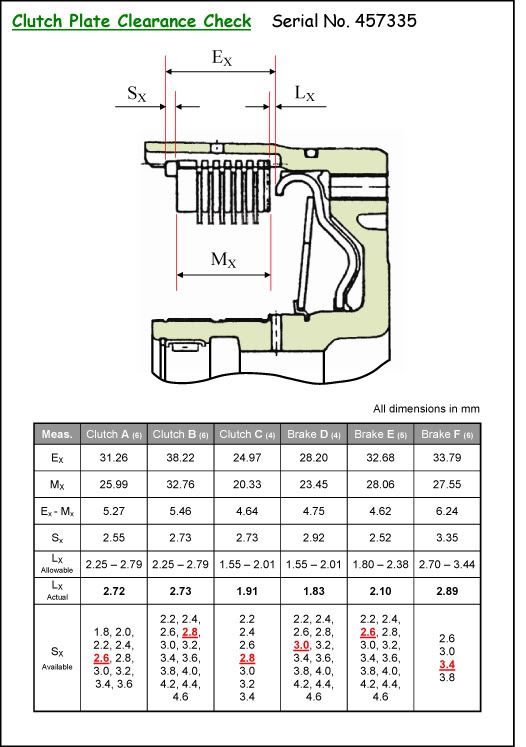
P.S. Regarding the ‘fancy jig’ for setting up the clutch plate clearances, I simply use a 20.4kg weight (i.e. 200N) to preload the wavy plate which has a radial slot cut in it to allow the thickness measurements to be taken

Reply With Quote
  #2  
Old 05-03-2011, 06:28 PM
civdiv99's Avatar
Member
 
Join Date: Jan 2011
Location: Yakima, WA
Posts: 413
civdiv99 is on a distinguished road
Thanks. Have been off in work-mode for a couple of months. Have some downtime to read through some posts. I don't recall specifically regarding that o-ring. I replaced all of them in any case. Nailed it right on the head with the end-play. Not being familiar with what I was looking for upon disassy, I didn't take preliminary measurements. Once I saw that bearing, it all became clear.


Quote:
Originally Posted by RRPhil View Post
Congratulations on your excellent write-up civdiv99.

I’ve rebuilt around a dozen Range Rover 5HP24s in the past few months which had exactly this same “bearing then O-ring” failure http://forum.landrovernet.com/showthread.php/189983-ZF-5HP24-teardown and it looks as though it will become a common problem on the 4.4i & 4.6is E53 too as their mileages rack up.

The axial needle roller bearing which wears & fails only sees a combination of load and relative speed in gears 1, 2 & 3 so I suspect it will be vehicles that have worked hard in these gears throughout the vehicle’s lifetime which will suffer this particular failure (towing, ‘sporty’ driving, hilly terrain, etc.). Vehicles that spend their lives predominantly cruising up and down the motorway are likely to be safe from this particular failure.

Please forgive me if I missed it, but reading through your excellent posts I notice that you didn’t make specific reference to the condition of the O-ring which seals the input shaft to the B-clutch drum so I think it’s worth pointing out that it’s the failure of this O-ring which allows the A-clutch pressure to bleed to tank (& therefore drive is lost in gears 1 to 4) and that the O-ring fails because the axial bearing wear allows the input shaft and B-clutch drum to separate under load (as you stated). Perhaps you could confirm that this O-ring had failed in your case?


It’s easy to identify if a 5HP24 has this specific problem when it’s sat on a bench, even before stripping it, by grabbing the input shaft and trying to move it axially. The correct endfloat is 0.2 to 0.4mm. If the axial bearing has worn/failed you will be able to move the shaft by 1-2 mm.

Phil

P.S. Regarding the ‘fancy jig’ for setting up the clutch plate clearances, I simply use a 20.4kg weight (i.e. 200N) to preload the wavy plate which has a radial slot cut in it to allow the thickness measurements to be taken

Reply With Quote
Reply

Bookmarks

Thread Tools
Display Modes

Posting Rules
You may not post new threads
You may not post replies
You may not post attachments
You may not edit your posts

BB code is On
Smilies are On
[IMG] code is On
HTML code is Off
Trackbacks are On
Pingbacks are On
Refbacks are On


All times are GMT -4. The time now is 08:29 AM.
vBulletin, Copyright 2026, Jelsoft Enterprises Ltd. SEO by vBSEO 3.6.0
© 2017 Xoutpost.com. All rights reserved. Xoutpost.com is a private enthusiast site not associated with BMW AG.
The BMW name, marks, M stripe logo, and Roundel logo as well as X3, X5 and X6 designations used in the pages of this Web Site are the property of BMW AG.
This web site is not sponsored or affiliated in any way with BMW AG or any of its subsidiaries.